One passage rendered twice through De-Esser 1.0.0 at 44.1 kHz, untouched and in Control mode. Below 2 kHz the two are identical; the reduction is centred on 6-8 kHz. Judge the sibilants, not the level.
StudioZIO software
StudioZIO De-Esser
A dynamic bell, or a split band.
Two de-essing modes behind one control: Natural for a dynamic bell that targets the sibilance, Control for split-band reduction above 5 kHz, with the gain reduction on its own meter.
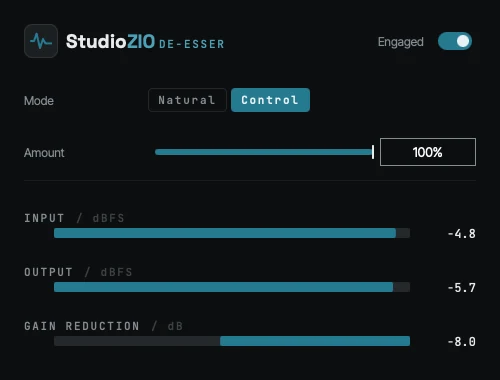
The De-Esser window
Hear it
The same passage, twice
One passage rendered twice and switched instantly, so the playhead never moves. Both takes are matched to −18.0 LUFS integrated: at different levels the louder one always wins and the comparison tells you nothing. The peaks are left alone, because the difference between them is the work.
Modes
Two ways to take the edge off
Both work on the sibilance and leave the body alone. They differ in how narrowly they reach for it.
- Natural
- A dynamic bell around 7 kHz, narrow enough to leave the rest of the top end where it is.
- Control
- A split band above 5 kHz, held down as a whole for firmer, steadier reduction.
Surface
Deliberately simple
De-Esser does one job, so its window asks one thing of you at a time.
- Mode
- Natural or Control.
- Amount
- How much of the chosen mode you get.
- Engaged
- Crossfaded bypass, switched without a click.
- Metering
- Input, output and gain reduction, live.
- Latency
- 0 samples, in either mode.
Official macOS installer
De-Esser 1.0.0
Version 1.0.0 · Audio Unit (AU) · VST3 · AAX · Standalone
- Installer
StudioZIO-De-Esser-1.0.0.pkg- Platform
- macOS
- Latency
- 0 samples, in either mode.
- SHA-256
- 698a5c45dc530b97bd4fc3c9f6e401bf4cbb414a435ff1d4235f6afa66e661f2
Help
Support
Bug reports and technical questions reach the person who writes the code, through the contact form.